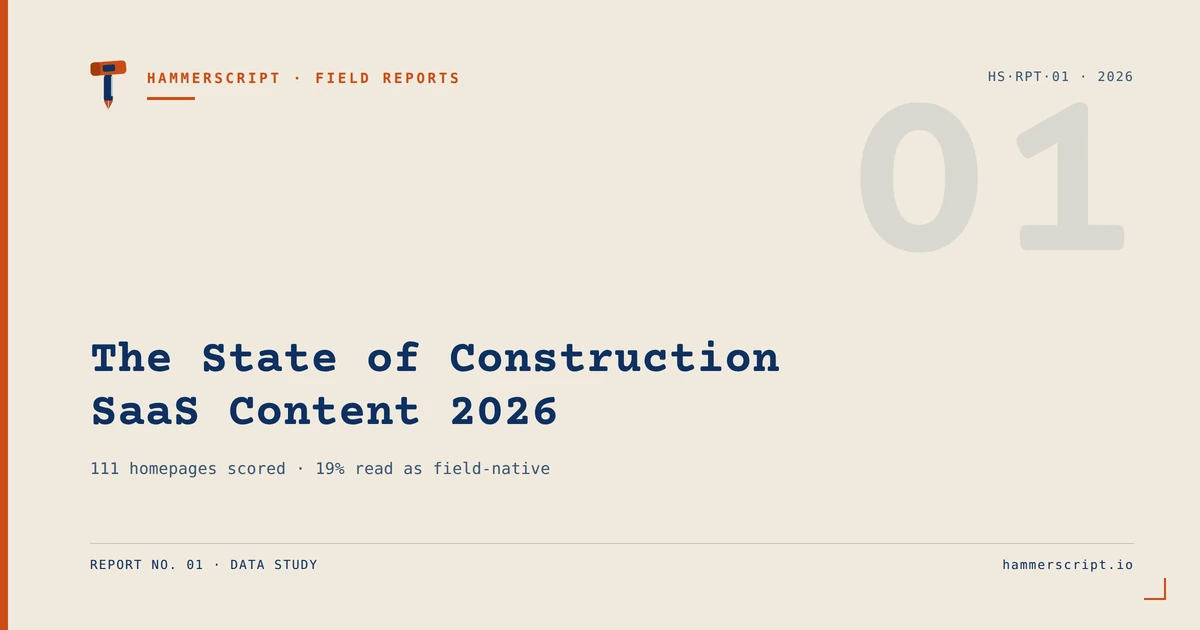
The State of Construction SaaS Content 2026
We scored 111 construction software homepages for field language. Fewer than 1 in 5 passed.
Open ChatGPT, ask it to recommend estimating software, and read who it names. Then read those companies’ homepages. The pattern will ruin the rest of your quarter.
Ask a superintendent to read ten construction software homepages back to back and they’ll start laughing by the fourth one. The products behind them are wildly different. The copy isn’t: swap the logos and nobody could tell you which company builds takeoff software and which one does field safety. Every page says “construction.” Almost none of them sound like it.
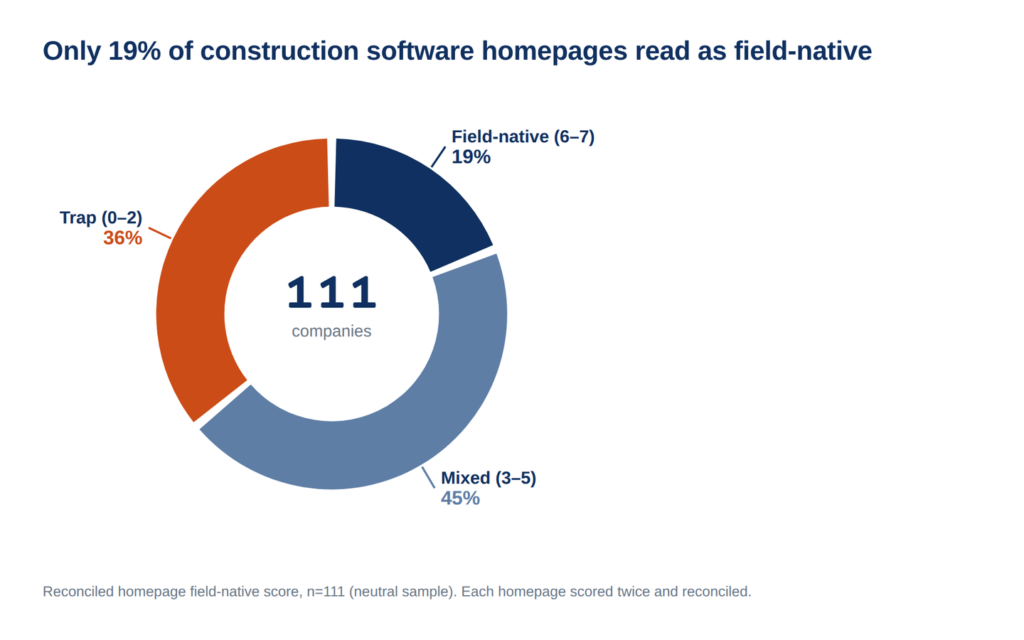
We wanted to know how widespread that is, so we measured it. We scored the homepage of 111 construction SaaS content companies against seven signals of whether the writing came from someone who understands the job or someone guessing at it, what we call the Job-Site Tell. Every page was scored twice, in two independent passes against the same rubric, and the two scores reconciled. This is what construction software marketing content actually looks like in 2026, and the number that matters is small: only 19% read as unambiguously field-native. Close to half, 47%, failed four or more of the seven tests.
The 7 signals of field-native construction content
Each homepage got one point per signal, zero to seven. The signals are not about grammar or polish. They’re about whether the writing knows the work:
- Does it name a specific project type or trade, a healthcare fit-out, a Division 8 hardware schedule, a heavy-civil job, or just “construction”?
- Does it name a real role, estimator, superintendent, PM, foreman, controller, or only “users” and “teams”?
- Does it describe cost in field terms, a blown change order, rework, a closeout surprise, an RFI that sat too long, or in ROI percentages?
- Does it name real tools and standards, Procore, Autodesk, Sage, the CSI divisions, or “your existing solutions”?
- Is there one sentence a PM would actually say out loud?
- Could the exact paragraph describe software in any other industry with the word “construction” swapped out?
- Does it read like it was written by someone who’s lived the problem, or by someone selling the tool?
Zero to two is trap content. Six or seven is field-native. Most of the industry lives in the mixed middle, and it leans low.
Why construction software marketing content sounds generic: voice, not topic
The scores exposed where the failure sits. Roughly 86% of the companies clear the easy part: they mention construction, they say the word, they pin the page to the industry. What they miss is the part that can’t be faked. On the two signals that require sounding like the field, a real spoken sentence and copy that reads as lived rather than sold, most pages failed.
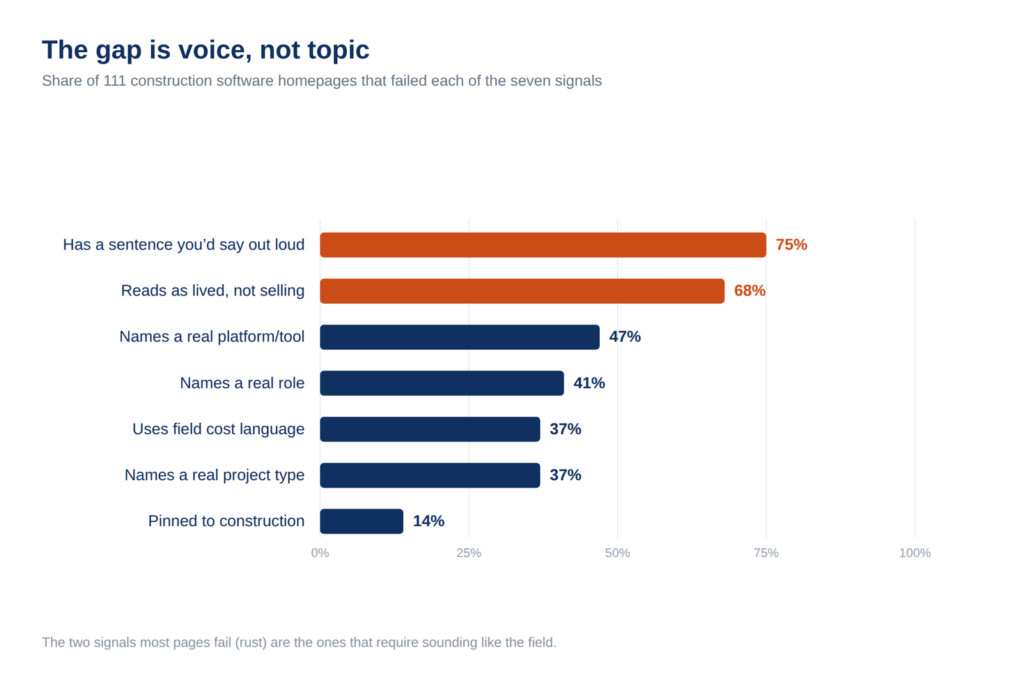
Underneath the numbers, the finding is blunt: naming the category has become the new generic. Ten years ago, writing “for contractors” was enough to signal you understood the buyer. Now every company writes it, the same handful of AI tools generate it, and the phrase carries no information. The homepage that says “purpose-built for construction professionals” and the one that says “your PM stops being the cleanup crew” are both technically about construction. Only one of them was written by someone who’s been on the receiving end of a rollout that didn’t take.
A construction professional can feel the difference in about four seconds. So can an AI answer engine, for a different reason we’ll get to.
What most construction SaaS companies get wrong about flat content
The common assumption is that flat content is a writing problem: hire a sharper copywriter, tighten the headline, add a keyword. That fixes the wrong layer. The specificity that makes content sound field-native isn’t a style you apply at the end. It’s information you either have or you don’t.
“A Division 8 estimator running a 700-door healthcare hardware schedule” is not a better-written version of “estimators who manage complex projects.” It’s a different sentence because it was built from a real fact the writer had access to. You can’t polish your way to a detail you never gathered. The companies scoring six and seven weren’t better at marketing. They were closer to the field: the founder came off a jobsite, or the team interviews its own customers, or someone on staff has run the workflow they’re describing. The flat pages read flat because the writing started from a product roadmap instead of a real day.
This is also why the fix doesn’t come from a better prompt. Feed a language model the same generic brief and it returns a more fluent version of the category average, because the average is what it was trained on. The only input that survives is a fact the model never had: a real quote, a real number, a real role, a real job.
How to audit your construction software homepage for field-native language
You don’t need our spreadsheet to see where you stand. Open your homepage and score it honestly against the seven signals above. Two questions do most of the work:
Would a PM read your hero line out loud to another PM without smirking? And could you paste your top paragraph onto a fintech or a logistics site, swap one word, and have it still make sense? If the answer to the first is no and the second is yes, you’re writing trap content, and no amount of design is going to move a buyer who’s already decided you don’t get it.
Most pages fail on the same three signals: no real role named, no real tool named, no sentence anyone would actually say. Those are also the three easiest to fix if you have the source material, and impossible to fix if you don’t.
When the field-native standard does not apply
The seven signals are for marketing content, the pages meant to earn a buyer’s trust. They are not a standard for technical documentation, API references, or in-product copy, which are supposed to live in product register and should stay there. A CTO reading your integration docs wants precision, not a spoken sentence from a foreman. Scope the field-native standard to the content whose job is trust, not the content whose job is reference.
How we scored 111 construction software homepages, and how reliable it is
We’re publishing the method because the finding depends on it. The scoring was done by an AI system against a fixed seven-signal rubric. Every homepage scored twice, in two independent passes, and the two passes reconciled. Those passes landed within one point of each other 71% of the time. That’s decent but not airtight, and we’re not going to pretend it’s better than it is. The disagreement clustered exactly where you’d expect: the two passes agreed easily on the objective signals (is a role named, is a platform named, is a project type named) and diverged on the subjective one, whether a line “sounds lived.”
That split is the point, not a flaw in it. The part of field-native writing that’s easy to verify is the part that’s easy to fake: drop in a role title, name-check Procore, list three trades. The part that’s hard to score is the part that actually earns trust, and it’s hard to score for the same reason it’s hard to fake. If your content only clears the checkable signals, you’ve built the marketing equivalent of a set of plans that pass plan check but can’t be built. It looks right to a filter and wrong to a foreman.
So read the headline as a band, not a decimal: fewer than one in five construction software companies has content that reads as genuinely field-native, and about half fail the basics. The exact percentage will move a point or two depending on how it’s scored. The shape won’t.
Construction software marketing content: frequently asked questions
What does “field-native” content actually mean?
Content written in the language the buyer uses on the job, real roles, real trades, real tools, real costs, rather than the language a product team uses in a roadmap meeting. It’s the difference between “reduce administrative overhead” and “your PM stops chasing signatures at 6 p.m.”
Isn’t naming Procore or a specific trade just keyword stuffing?
No. Keyword stuffing repeats a phrase to game a ranking. Naming a real platform, role, or project type adds information a buyer and an answer engine can both use to place you. The test is whether the detail is true and specific, not whether it’s frequent.
Why does AI search reward this kind of writing?
Answer engines don’t rank pages so much as retrieve quotable passages that answer a question. A sentence with a named platform and a real number can be lifted out, quoted, and still be true. “We streamline construction workflows” matches nothing a buyer actually asks. Specificity is what gets retrieved.
We don’t have field experience in-house. Can we still write this way?
Yes, but not by guessing. The specificity has to come from somewhere real: your own sales calls and support tickets, or interviews with the practitioners your product serves. You can source field language without having lived it. You can’t invent it.
Does more content help?
Not on its own. A hundred pages of category-average copy move nothing. One page built from a real quote and a real number outperforms them, in front of buyers and in front of the models that now sit between you and buyers.
Key takeaways
- Only 19% of 111 construction software homepages read as field-native, and 47% failed four or more of seven basic signals.
- The failure is voice, not topic: 86% mention construction, but far fewer sound like they’ve lived it.
- Field-native writing is a sourcing problem, not a copywriting problem. You can’t polish your way to specificity you never gathered.
- The signals that earn buyer trust are the same ones that can’t be faked, which is why most content clears the checkable tests and fails the human one.
Construction software marketing content converges on the category average because everyone writes from the same product briefs with the same tools. The way out is the one thing a model can’t generate and a competitor can’t copy: a real detail from the field. That’s the entire discipline, and most of the industry hasn’t picked it up yet.
HammerScript builds construction SaaS content from both sides, the practitioners who live the problem and the teams who build the fix, so it reads like it came from inside the industry. hammerscript.io