Position 1 on Google, Invisible to ChatGPT: What 56 Tracked Queries Showed Over Two Months
Your traffic report says the content is working. Your buyer just asked ChatGPT which tool to use, heard three names, and none of them was yours.
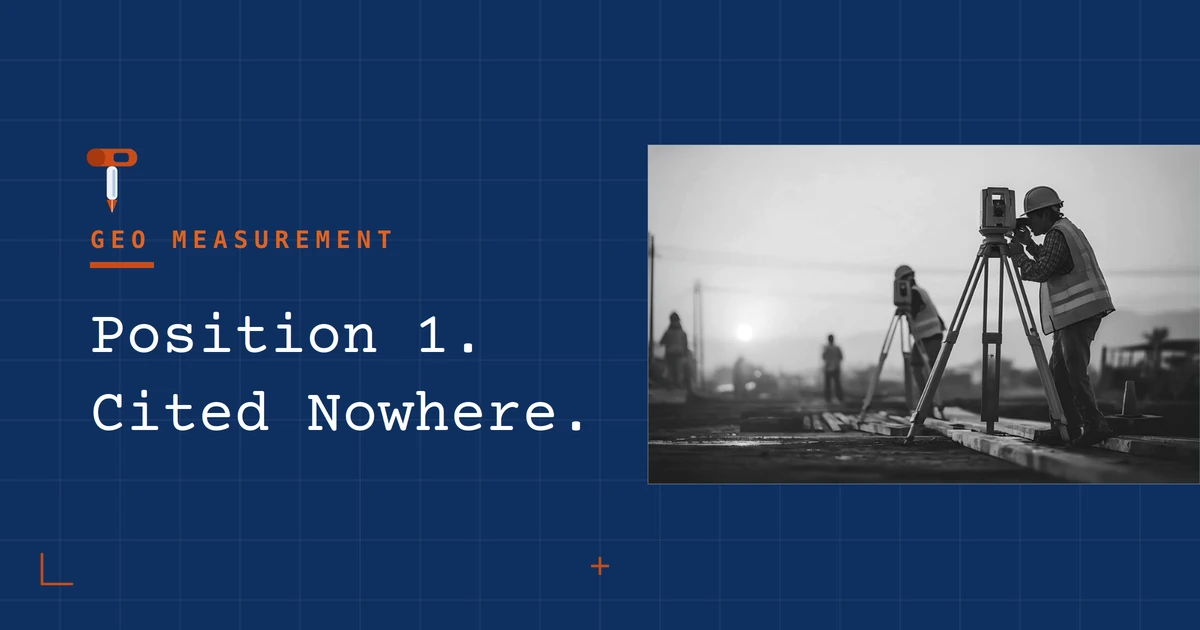
A page can hold the top organic result on Google and earn no citation at all in the AI answer for that same question. I found one doing it in August, on a client’s site I’d been measuring since June, and it’s the most useful thing I’ve learned about content all year. The two channels are reading different signals off the same page, which is why you have to measure AI search visibility separately from anything Google Search Console shows you.
In July I argued here that construction software companies vanish the moment a buyer asks ChatGPT or Perplexity, and that specific, field-sourced content is what gets cited instead. That was a claim, and claims are cheap. What follows is an attempt to measure AI search visibility properly on a real client’s site, including the parts that didn’t work.
What a page ranking first with zero AI citations tells you
Google organic
#1
Top result on the page.
AI citations
0
Not cited by any of the three engines.
The same URL, the same buyer question, scanned the same morning.
Classic ranking rewards a set of signals that overlaps with what an answer engine looks for without matching it. A page can satisfy the first and fail the second, which means a marketing team watching only impressions and clicks can be losing the AI channel for months while every dashboard stays green. That’s the argument for measuring both, and it’s the argument I’d have skipped if I hadn’t gone looking.
How to measure AI search visibility without fooling yourself
The method is a basket, not a result. Before anything published, I ran a baseline across Google AI Overviews, Perplexity and ChatGPT on every question the piece was written to answer. Almost always the client appeared nowhere. Then the same questions get re-scanned roughly thirty and sixty days after publishing, so what comes back is a before and an after on a fixed list rather than a number with nothing behind it. That structure is doing most of the work. Ahrefs used the same shape of design to test whether adding schema markup lifts AI citations, tracking 1,885 pages that added JSON-LD against 4,000 matched control pages, and found no meaningful uplift on any platform. That answer only exists because somebody measured before and after instead of reasoning about it.
Each square is one question this company’s buyers actually ask. Ten articles over roughly two months, on a small site that started invisible.
Two things about that picture are deliberate. The basket grew from 24 questions to 56 because tracked queries get added as articles ship, and hiding a moving denominator inside a percentage is how honest measurement turns into marketing. And these are raw counts. A rate would read better and tell you less.
The result worth more than the totals is a single unbranded question, meaning someone asking what tools exist rather than asking about this company by name. Google’s AI Overview now answers it by naming the client alongside two competitors. That reader didn’t know the company existed.
Which engines move first
Perplexity reacts fastest to new work on a site. ChatGPT builds much of its answer from places the company doesn’t own.
That last detail changes where the next quarter’s effort goes. If an engine assembles its answer largely out of forum threads and third-party review pages, publishing harder on your own domain has a ceiling, and the work shifts toward getting named on pages you don’t control.
The article that produced nothing
Zero citations on any engine, on every scan since June.
One of the ten pieces has returned nothing, and two months is long enough to stop waiting on it. My read is that the tracked questions are wrong rather than the topic, since the piece covers something buyers demonstrably care about and I probably wrote the queries the way a marketer would phrase them instead of the way a practitioner types them. Rewriting the queries costs the client nothing and settles it next cycle. A report without a section like this one is marketing.
What it costs to find out
This is the arithmetic a founder runs, so it’s worth putting your own numbers into rather than taking mine.
28 questions moved from uncited to cited across the two months.
Read that as the cost of running the experiment, not as a return. Whether a citation produces a demo is the one link in this chain I can’t yet prove, and I’d rather say so than dress a correlation up as a forecast. What the numbers do support is narrower and still worth something: a small site with no authority went from three answers to thirty-one in about eight weeks, and it’s measurable enough to know which pieces earned it.
How to measure AI search visibility on your own site
Write down the questions your buyers actually ask, in their words, before you publish anything. Scan all three engines and record who gets cited today, because that baseline is unrecoverable once the article goes live. Re-scan the same list at thirty and sixty days. Keep the counts raw. And check your top-ranking pages against the AI answers for the same questions, because the ones sitting at position 1 with no citation are the pages telling you the most.
If none of that gets done, the honest position isn’t that content is working or failing. It’s that nobody knows, which is the position most construction software companies are in right now.
Common questions
How long before AI engines cite a new article?
In this measurement the first citations appeared within about thirty days of publishing, and Perplexity moved earliest and most. Google AI Overviews moved more slowly and in smaller numbers. Answers also churn in both directions, so a question cited on one scan can go uncited on the next, which is the reason to track a basket instead of a single result.
Does ranking on Google mean AI engines will cite you?
No. This scan found a page holding Google position 1 that earned zero AI citations for the same question, and separately found pages cited in AI answers that ranked further down. Treat them as two channels that need measuring separately.
How do you measure AI search visibility?
I use ZipTie for the scanning, across Google AI Overviews, Perplexity and ChatGPT. The tool matters less than the discipline around it: a fixed question list, a baseline recorded before publishing, and raw counts rather than rates.
Why raw counts instead of percentages?
Because the denominator moves. Tracked questions get added as new articles ship, so a percentage quietly changes meaning between scans while looking like a clean comparison. Counts keep the change visible.
The short version
Ten articles, 56 tracked buyer questions, three engines, two months. Citations went from 3 of 24 to 31 of 56, one article produced nothing at all, and a page ranking first on Google earned no AI citation whatsoever. Every one of those is only knowable because the baseline was captured before anything published.
I write field-sourced content for construction software companies, and I measure it this way for every client. If you want the field-level observations that feed this work, they go out every two weeks in Field Notes. If you’d rather talk about what your own baseline looks like, I’m at howdy@hammerscript.io.
Scans run with ZipTie across Google AI Overviews, Perplexity and ChatGPT, United States. Full 56-prompt re-scan August 4, 2026, read after the scan fully settled. Baselines captured per article before publication between June 9 and July 23, 2026. The client asked to stay unnamed and I’m honoring that, so the figures here are the whole of what I can show. Their tracked question list and Search Console data are theirs, not mine to circulate.